






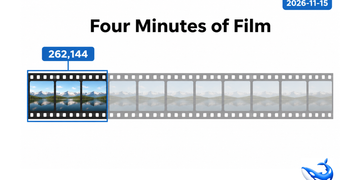

















Video input is rare on OrcaRouter‘s cyber tier. The Qwen3.8 Flash Next uncensored card takes text, image and video, and holds 262,144 tokens of context [OURS].
Those two rows are advertised together and they sit awkwardly together. Video is the input that consumes a window fastest, and this card has a quarter of the window that five of its neighbours do.
The result is a card with a video capability that is real and bounded, and the boundary lands at a few minutes rather than hours. Knowing where it is decides whether the capability is usable for your work.
The frame budget, worked out
Video is converted to frames and frames are billed as input tokens. A rough working figure is around 1,000 tokens per frame at moderate resolution [OURS, our approximation]; the exact number depends on the frame’s pixel budget and the provider’s tiling, and no card on this tier publishes it.
Take the 262,144-token window and reserve a tenth for the prompt, the instructions and the output. That leaves roughly 236,000 tokens of frame budget, which is about 236 frames at 1,000 tokens each.
| sampling rate | clip length that fits |
| 4 fps | 59 seconds |
| 1 fps | 3.9 minutes |
| 0.5 fps | 7.9 minutes |
| 0.2 fps | 19.7 minutes |
The frame count is fixed by the window; the sampling rate only decides how much time those 236 frames cover. Read it that way and the constraint becomes a choice: the window gives you 236 frames, and you decide how many minutes of footage they represent.
At four frames a second you get under a minute. At one frame a second you get four minutes. At one frame every five seconds you get nearly twenty.
So the practical question is not “how much video” but “how much movement do I need to see”. A screen recording where a human clicks through a console needs around one frame every two seconds; a camera feed where a person walks past needs more.
What four minutes covers
Four minutes of video is a lot of security work and not much of anything else.
A single exploitation session. Start to shell, screen recorded. Four minutes is usually enough and when it is not, the interesting part is short and the rest can be sampled sparsely.
An alert triage clip. Camera footage from a door or a rack. The event is seconds long.
A reproduction recording. A vulnerability demonstrated end to end. These run short by design.
A log-scrolling walkthrough. Reading a terminal over time. This is where four minutes is tight and where sparse sampling works, because the content changes slowly.
What it does not cover: a full incident review meeting, a multi-hour session, or a training video. Those need chunking, and chunking changes the shape of the work.
The chunking pattern that actually works
Three steps, and each one is small.
Segment on scenes rather than on time. Splitting a thirty-minute recording into ten three-minute chunks cuts across the moments you care about. Splitting on visual change gives you chunks that are internally coherent.
Summarise each segment to text. One call per segment, each asking for a structured summary — what appeared, what changed, what was said. The output is a few hundred tokens per segment.
Analyse the summaries. A final call reads all ten summaries, which is a few thousand tokens, and reasons across the whole recording.
The cost is ten calls instead of one, and the benefit is that the analysis sees the whole timeline instead of four minutes of it. On a $0.80 input rate the extra calls cost single-digit cents.
What the card brings besides video
The four rows that matter on top of the modalities.
94.0 output tokens a second — third fastest in the tier, behind Hy4 at 173.7 and MiniMax at 129.9 [OURS]. A transcript-length response from a four-minute clip produces in about twenty seconds.
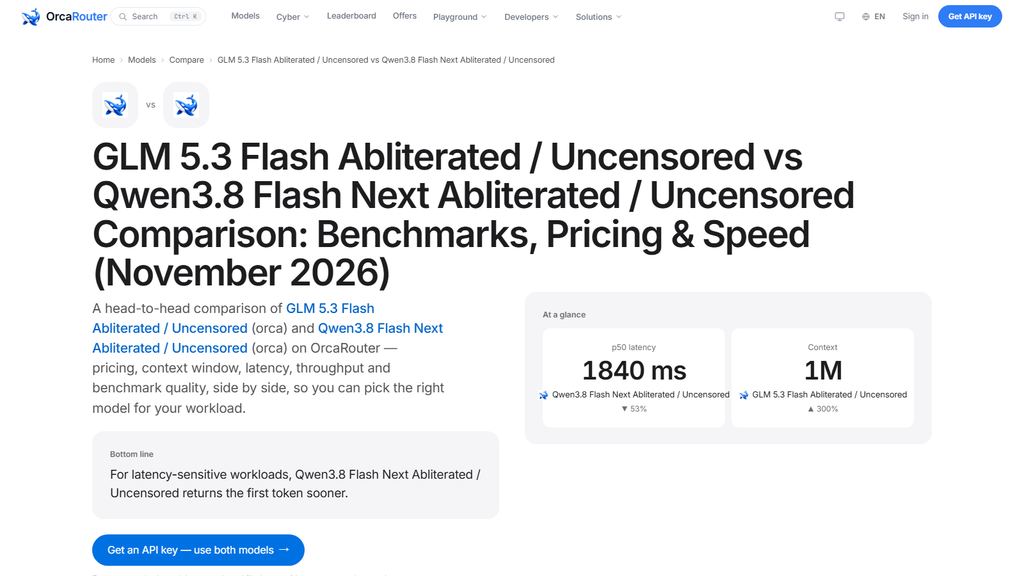
1,838 ms median first token with a daily series that runs 1,720 to 2,700 ms [OURS]. Not the steadiest card here, and not a volatile one.
0.603% errors, and ZDR available [OURS]. Both matter for footage that contains faces.
All three endpoint shapes — chat-completions, Responses and Messages — with 17 parameters [OURS]. One of seven cards with the full protocol surface.
That is a well-equipped card. The window is the single constraint, and it is a hard one.
Why the traffic is low
1.86 billion tokens in the seven days to 2026-11-15, the second-lowest on the abliterated side of the tier and about a nineteenth of DeepSeek’s 32.99 billion [OURS].
The obvious explanations do not survive contact with the rows. It is not slower — 94.0 tokens a second beats six of the eight abliterated cards. It is not less reliable — 0.603% errors is third best. It is not less capable on paper — five benchmark rows and the full protocol surface.
The window is what is left. A quarter of the context that five neighbours offer, at an identical $0.80 in and $1.60 out, is a real disadvantage for anyone whose prompt is a repository or a long document, and most security work in this tier is exactly that.
Video input does not offset it: the six cards without video are not short of traffic, and the two cards with a small window are the two quietest on the abliterated side. That correlation is the closest thing to a cause in the data.

What to pair it with
The tier’s other cards make the small window cheap to work around, and three pairings cover most video work.
Qwen for the frames, GLM 5.3 Flash for the document. Qwen reads four minutes; GLM 5.3 Flash writes a long report at a 1,048,576-token window. The transcript goes in as text.
Qwen for the frames, DeepSeek for the reasoning. DeepSeek’s 998 ms median and 186.1 tokens a second make it the better card for the analysis step, and its million-token window takes the accumulated summaries without complaint.
Qwen alone, when the deliverable is a classification. A four-minute clip, a verdict and a reason. No window problem, no second call.
The pattern in all three is that video reading and long reasoning are different jobs and the tier has different cards for each.
How to test whether it fits
One afternoon of work and two measurements.
Take ten representative clips and count how many fit in 236 frames at your sampling rate. If it is nine or ten, the window is not your constraint and the card is a candidate on its other rows.
Take the same ten and run them at two sampling rates, one you consider sufficient and one half of it. Compare the answers. If they agree, you were sampling too densely and the window just got twice as large.
The second is the one most teams skip, and it is where the four-minute limit dissolves: half the frame rate is double the clip, and video work rarely needs the density people assume.
The short version
Text, image and video in at $0.80 and $1.60, with a 262,144-token window that gives about 236 frames — four minutes at one frame a second and twenty at one frame every five seconds.
The card is well equipped on every other row: 94.0 tokens a second, 0.603% errors, ZDR, all three endpoint shapes. The window is the one constraint and it explains the card’s low traffic better than any other row.
Sample sparsely, chunk on scenes, and pair it with a million-token card for the write-up. That turns a four-minute capability into a pipeline that sees the whole recording.
Sourcing note: modalities, context windows, output ceilings, prices, latency, throughput, error rates, traffic, ZDR flag, parameter surface and endpoint types are read from the card’s public model data on 2026-11-15, with seven-day windows ending that day [OURS]. Frame-budget and cost arithmetic is our own approximation at roughly 1,000 tokens per frame; no card publishes its tiling. Benchmark rows are OrcaCyber’s own, evaluated 2026-08-25 [VENDOR].